Every parent has lived a version of this moment. A child reaches out, calls out, needs something — and you, for reasons practical or intentional or simply human, cannot give it to them right away. The guilt is immediate. So is the doubt. And so, often, is the loud and tearful protest from the small person doing the asking.
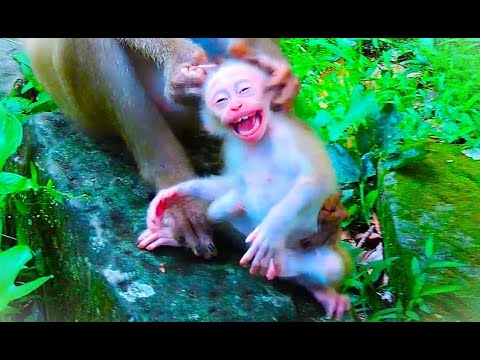
In a video shared by Monkey Library on YouTube, that exact dynamic plays out — not between a human parent and child, but between a young monkey named Leo and his mother. And somehow, it lands just as hard.
Leo’s cries in the footage are loud, sustained, and deeply expressive. His face, captured in close detail by the Monkey Library camera, is a study in unfiltered emotion — the kind of honest distress that only the very young can produce, because only the very young have not yet learned to temper how much they feel or how openly they show it. He wants his mother. She is there, but not entirely available in the way he needs. And the gap between those two facts is, for Leo, enormous.
For viewers watching from the other side of a screen, the response is often immediate and instinctive. Comments on Monkey Library videos frequently reflect this — people tagging friends who are new parents, people writing about their own children, people noting, with some surprise, how deeply a young monkey’s expression can reach into something personal and familiar.
That reaction is not accidental, and it is not sentimental projection without basis. Primates share significant emotional and neurological architecture with humans. The attachment systems that make Leo cry for his mother are the same fundamental systems that make human infants cry for theirs. The distress is real. The need is real. And the process of learning to tolerate distance — emotional or physical — from the one who means safety and warmth is one of the most formative challenges any young social creature faces.
Monkey Library’s value, in this context, goes beyond entertainment. By documenting the lives of individual animals like Leo with consistency and care, the channel creates something genuinely educational — a long-form portrait of primate life that helps viewers understand their own emotional lives more clearly by observing them reflected in another species.
Leo’s moment of anguish in this video will not last. His mother will, in all likelihood, draw close again. The rupture will repair. That is what healthy attachment looks like — not the absence of disconnection, but the reliable return after it. That rhythm of separation and reunion, repeated over and over through childhood, is what eventually builds trust deep enough to last a lifetime.
For now, though, Leo cries. And those of us watching find ourselves, unexpectedly, a little moved — reminded that love, in all its forms, sometimes sounds exactly like this.
Source: Monkey Library, YouTube.
Watch the original video →